


Direct Answer
A finish mower delivers a manicured, striped cut at lower cost and lower HP demand. A flail mower handles uneven terrain and longer vegetation, producing acceptable results on established turf, though not a golf-course finish. On mixed properties with both maintained lawn and rough sections, a flail mower often handles both jobs well enough to make a second machine unnecessary.
TL;DR
Most compact and utility tractor owners end up with the same property profile: maintained lawn close to the house, rough field margins, fence lines with irregular growth, and a stretch of ditch or bank that sees seasonal overgrowth. One machine handles all of that only if it is the right one. For most of these properties, the question is not whether to buy a mower but whether to buy two.
Root Revive Direct's tow-behind rough cut mowers include flail options for buyers working through exactly this decision.
A finish mower uses a wide, low deck with three overlapping blade arcs spinning at 10,000 to 18,000 feet per minute. That blade speed on established short turf produces a clean, level cut across the full deck width in a single pass. The result is the striped lawn look associated with golf courses, parks, and professionally maintained properties.
The deck floats on gauge wheels or rollers that set cutting height, typically from 1 to 3 inches. Because the deck is rigid and rides close to the ground, it follows the general plane of the terrain but does not flex around individual high or low spots. A high point in the lawn means the deck contacts that spot and scalps the grass there; a low spot means the deck passes above it and leaves that growth untouched.
Finish mowers run on relatively low PTO horsepower. A 60-inch finish mower typically requires 15 to 22 PTO HP, which puts it within reach of most sub-compact and compact utility tractors. That lower HP demand is one of the main reasons finish mowers remain practical even where tractor horsepower is limited.
The trade-off is narrow material tolerance. A finish mower handles short established grass only. Tall vegetation, wet clippings that mat under the deck, or any stem thicker than light grass will slow or stall the machine and risk damage to the blades or spindles. A finish mower that encounters rough terrain or heavy growth is the wrong tool for the job, regardless of operator skill.
A flail mower drives a horizontal rotor shaft that spins parallel to the ground. Dozens of individual blades, called flails, attach by pivot pins along the rotor's length. As the shaft spins, the flails extend outward and strike vegetation, re-cutting material multiple times inside the housing before discharging it as fine, shredded mulch.
Front and rear rollers on the flail mower control cutting height from roughly three-quarters of an inch to 6 inches, with the rollers maintaining constant clearance relative to the actual ground surface rather than a fixed deck plane. Where a finish mower's rigid deck rides over a high spot and scalps it, the flail mower's rollers follow the contour and hold consistent cut depth.
Flail mowers handle a wider range of conditions than finish mowers: short established turf, tall vegetation, wet or stemmy material up to roughly 2 inches in stem diameter, and terrain with uneven or sloped surfaces. That capability comes at higher PTO horsepower demand per foot of cutting width, which limits their use on smaller sub-compact tractors.
| Feature | Flail Mower | Finish Mower |
|---|---|---|
| Cut mechanism | Hinged flails on horizontal rotor | Multiple spinning blades under rigid deck |
| Cut quality | Tidy on maintained turf; not manicured | Manicured; striped |
| Vegetation limit | Up to 2-inch stems | Short established grass only |
| PTO HP demand | Higher | Lower |
| Height precision | Roller-controlled; consistent on uneven terrain | Deck-fixed; scalps high spots |
| Terrain tolerance | Rough, sloped, and uneven ground | Flat, maintained surfaces only |
| Debris safety | Low throw risk; hinged blades swing back on impact | Low throw risk inside closed deck |
| Price | Higher | Lower |

The most visible difference between these tools is the surface left after a pass.
A finish mower's blade speed of 10,000 to 18,000 feet per minute cuts grass cleanly at the tip across an even plane. Clipping volume on short, maintained turf is low enough that most operators do not need to collect; clippings settle into the canopy quickly and the striped result is visible immediately after the pass.
A flail mower re-cuts material inside the housing and deposits it as fine mulch across the surface. The cut is tidy but not blade-clean. There are no defined rows or striping pattern, and the discharged material sits visibly on the surface for a day or two before it settles and begins decomposing.
Ohio State University Extension researchers Tyler Q. Carr, David S. Gardner, and Edward J. Nangle document in "Lawn Mowing" (Ohioline HYG-5816, 2023) that lawns mowed too short develop shallow root systems with less total mass than turf maintained at proper cut height, and that shallow roots reduce drought tolerance and increase susceptibility to weed pressure.
That finding explains why cut-height consistency matters as much as tool selection in maintaining healthy turf. A finish mower's rigid deck scalps elevated spots and triggers shallow-root stress in those areas; the flail mower's roller-controlled height system maintains more consistent clearance over uneven terrain, reducing the frequency of height-related stress across the cut surface.
For flat, manicured-appearance-focused turf, the finish mower wins on cut quality. For mixed or uneven turf where consistent cut height is harder to guarantee pass by pass, the flail mower's height control system is a practical turf-health advantage.

Close, but not the same.
On short, established turf that is cut regularly and kept below 6 inches of growth, a flail mower running Y-blades produces a visually tidy result. Most rural and suburban property owners who compare the two tools over the same patch of lawn find the flail mower's output acceptable, and on uneven terrain often find it better maintained than a finish mower contending with high spots and scalping.
What a flail mower does not produce: the blade-defined rows of a finish mower, the crisp grass-tip cleanness visible on a golf course or professional sports field, or the consistent stripe pattern that some property owners treat as an aesthetic goal in itself. If the primary purpose of the mowing is curb appeal for a listing, event presentation for a commercial venue, or manicured appearance as a business standard, that difference is visible and real.
The deciding question for whether a flail mower's output is acceptable is not technical. It is: who is the audience for the lawn's appearance? For personal use, rural estates, horse properties, and agricultural operations, the difference between flail and finish output becomes a matter of individual preference more than practical performance. For commercial venues, event-hosting properties, or business frontage where appearance is measured against a consistent professional standard, the finish mower's manicured result has value the flail mower cannot reliably replace.
A flail mower for lawn applications works well as long as the property does not require show-quality results on a predictable schedule.
Four conditions consistently point toward a finish mower as the correct tool.
Flat, maintained turf with no rough sections. If the entire mowing area is established short grass on a level surface with no terrain variation, a finish mower covers the ground faster, at lower HP demand, and at lower purchase cost than a flail mower of the same cutting width.
Show properties and commercial venues. When the lawn's appearance is part of a product: event hosting, commercial landscaping presentation, or a property in active marketing. The striped, manicured result of a finish mower is the standard the work is measured against in those contexts.
Limited PTO horsepower. A tractor in the 15 to 22 PTO HP range can run most 60-inch finish mowers without strain. That same tractor is often underpowered for a 60-inch flail mower in anything other than light vegetation conditions.
Dedicated lawn maintenance without any rough duty. For property owners who have separate equipment for rough work and need the lawn mower to do only tidy turf maintenance, a finish mower is the purpose-built, cost-efficient choice. Finish cut mowers suit this use case for buyers who have already separated the two equipment roles on their property.

Swisher Fast Finish Cut Trail Mower | 44-In.
A 44-inch tow-behind finish mower for clean, uniform cuts on flat established lawns and maintained pastures, the entry-level option for manicured appearance work.
Shop Now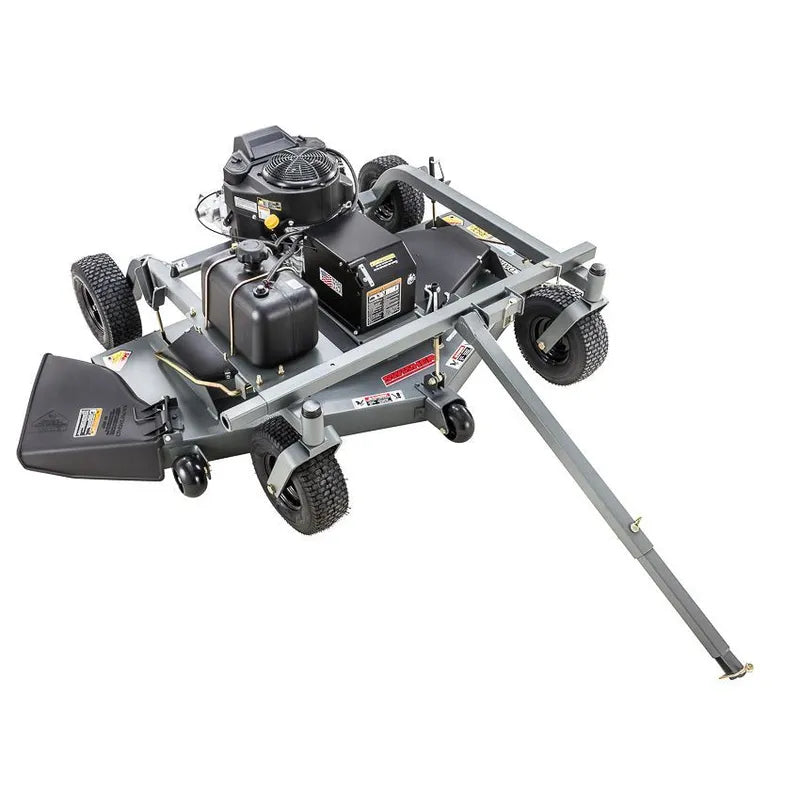
Swisher Finish Cut Mower | 60-In. Kawasaki
A 60-inch Kawasaki-powered finish mower with electric start, covers more ground per pass for large, level properties where appearance and cut consistency are the priority.
Shop Now| Property Type | Recommended | Reason |
|---|---|---|
| Residential flat lawn, no rough sections | Finish mower | Lower cost, lower HP, clean result on flat turf |
| Rural estate with mixed lawn and rough edges | Flail mower | Handles both; finish mower cannot do rough sections |
| Horse pasture | Flail mower | Finer mulch, shorter stem tips, lower debris throw risk |
| Orchard or vineyard floor | Flail mower | Precise height control, no thrown debris near equipment |
| Roadside ditch or sloped bank | Flail mower | Terrain tolerance; offset models available for slopes |
| Show property or commercial venue | Finish mower | Manicured appearance is a functional requirement |
| Small flat lawn, appearance is the priority | Finish mower | Cost-efficient for single-purpose flat turf maintenance |
| Mixed terrain with occasional rough growth | Flail mower | Versatility eliminates the need for a second machine |


Swisher Trail Cutter | 44-In. Tow-Behind
Entry-level tow-behind rotary cutter for tall grass and light brush where a finish mower cannot operate, handles overgrown margins, fence lines, and rough ground.
Shop Now
Kunz Engineering AcrEase Rough Cut Mower | 44-In.
The AcrEase 44-inch rough cut mower for overgrown fields and uneven terrain, a mid-range option for mixed-use properties that need one machine to handle both conditions.
Shop Now
Brave Rough Cut Mower | 57-In. Towable | Honda GXV630
A 57-inch Honda-powered rough cutter for large acreage with heavy vegetation, covers more ground per pass with serious engine power for the toughest clearing conditions.
Shop NowFor most mixed-use properties, a quality flail mower makes the finish mower redundant.
The practical case for owning both tools is narrow: a large, flat lawn section that is regularly used for events, commercial photography, or professional presentation, paired with a meaningful amount of rough mowing elsewhere on the property. At that point, the appearance standard on the lawn section is high enough that the finish mower earns its place in the equipment line, and the rough terrain justifies a separate flail mower alongside it.
For every other common property profile: rural estates with mixed terrain, horse farms, small farms with field margins, and properties where the lawn is maintained but not show-quality. In all of those cases, a flail mower handles the full mowing workload without requiring a second attachment. The purchase math reflects that: one higher-cost machine that covers both roles versus two lower-cost machines where only the lawn section overlaps. For most operators, one machine is the better use of the equipment budget.
The exception worth noting: a tractor with limited HP (sub-22 PTO) that cannot run a flail mower of adequate cutting width. In that case, a finish mower handles the lawn section correctly, and rough duty requires either a smaller flail mower sized to the available power or a walk-behind option for the rough areas.
When neither tractor attachment can reach a specific tight or confined area, walk-behind brush cutters extend mowing reach into corners and edges where a tractor-mounted implement cannot maneuver.
For comparison with the third common tractor mowing category, the companion guide to flail mower vs brush hog covers rough-clearing applications and the debris throw difference that separates those two tools from each other and from finish mowers.

On short, established turf, a flail mower produces a tidy result most property owners find acceptable. It does not produce the striped, manicured finish of a dedicated finish mower. For personal use, the difference is aesthetic. For show or commercial use, the gap is visible.
A finish mower is built for flat, maintained turf only. On rough ground, the rigid deck scalps high spots, stalls on tall vegetation, and risks blade and spindle damage. Use a finish mower on anything other than short, established grass and the result is uneven cut.
For flat, maintained turf, a finish mower produces the best cut quality. On uneven terrain, a flail mower's roller-controlled height system produces a more consistent result, avoiding the scalping that occurs when a finish mower's rigid deck encounters high spots.
Most mixed-use property owners do not need both. A flail mower handles maintained turf and rough sections in one machine. The case for owning both is narrow: a lawn section used for events or commercial presentation where the standard requires a manicured finish result.
Finish mowers cost less upfront, typically running in the mid-$400s to mid-$800s for common residential widths. Flail mowers of comparable width start in the low-$1,000s to mid-$1,500s. Flail mowers tend to hold resale value well, which narrows the long-term cost difference.
The finish mower is purpose-built for one task: a clean, manicured result on flat, established turf. On that terrain and for that goal, nothing in the tractor attachment category matches it for cost efficiency and cut quality.
The flail mower covers the same terrain acceptably while also handling everything a finish mower cannot. For mixed-use properties, that versatility makes the flail mower the more practical single-machine solution for most operators. Root Revive Direct carries rough cut and flail mower options for buyers ready to make the decision and find the model that fits their tractor and terrain.