


Direct Answer
Make two overlapping passes with a core aerator in perpendicular directions. Water the lawn the day before to soften the soil. The tines should pull plugs three-quarters of an inch in diameter and at least 2 to 3 inches deep. Leave the soil plugs on the lawn to break down naturally. Core aeration is the only method that reliably reduces soil compaction.
TL;DR
When water pools on a lawn after light rain, or grass thins despite regular watering, soil compaction is usually the cause. Compaction prevents air, moisture, and nutrients from reaching roots regardless of how much irrigation is applied. The fix is aeration, not more water.
This guide covers the two aerator types, how to aerate a lawn step by step, timing by grass type including St. Augustine, and how to aerate a small a lawn by hand when renting a machine is not practical. Root Revive Direct carries walk-behind lawn aerators for yards of every size.
Core aeration uses hollow metal tines to pull cylindrical plugs of soil from the ground, creating open channels for water, air, and nutrients to reach the root zone. Spike aeration uses solid tines to poke holes, pushing soil sideways rather than removing it.
That difference has consequences. On compacted ground, spike aeration increases the density of the soil around each hole because the displaced soil has nowhere to go except laterally. Core aeration is the correct method for any lawn with measurable compaction.
| Type | Removes Soil | Reduces Compaction | Best For |
|---|---|---|---|
| Core / Plug | Yes | Yes | Compacted lawns, overseeding prep |
| Spike | No | Often worsens it | Light maintenance on already-loose soil |
Core aerators pull plugs three-quarters of an inch in diameter and 2 to 3 inches deep. A spike aerator creates a surface hole but does nothing to break up the compression layer below grade.

Aerating during active grass growth gives the lawn the recovery time needed to fill in the holes before weeds can establish. Aerating during dormancy or drought stresses the grass without giving it the energy to respond.
Penn State's Center for Turfgrass Science documents that a compacted soil layer as thin as one-quarter to one-half inch can significantly impede water infiltration, nutrient penetration, and gaseous exchange between the soil and the atmosphere. That finding explains why lawns with surface compaction show stress symptoms even when watering frequency appears adequate.
Cool-season grasses (fescue, Kentucky bluegrass, perennial ryegrass): Early fall is the primary window, at least 4 weeks before the first expected frost. The soil is still warm enough for good tine penetration and the grass has a full season ahead to fill in. Early spring is a secondary option if fall aeration was missed.
Warm-season grasses (bermuda, zoysia, centipedegrass, carpetgrass): Late spring to early summer during active growth. Avoid aerating before the grass has fully broken dormancy in early spring.
St. Augustine grass spreads via above-ground runners called stolons rather than underground rhizomes. That growth structure changes both how compaction presents and when aeration should happen.
Aerate St. Augustine between late May and late June when stolon growth is at its most active. Avoid aeration from October through March; aerating during dormancy can damage stolons and delay spring green-up significantly.
After aeration, holes fill in through stolon spread rather than seed germination, which is why overseeding is not a standard follow-up step for St. Augustine the way it is for fescue or bermudagrass.
Before aerating, have the following ready:
Walk-behind core aerator rentals are available at most home improvement stores and equipment rental locations, typically priced by the half day or full day. For large or irregularly shaped properties, a tow-behind unit covers more ground with less operator fatigue.
All units below are tow-behind, compatible with most riding mowers and lawn tractors. For walk-behind units, check a local equipment rental center.

Strongway Plug Aerator | 48-In. Tow-Behind
A 48-inch plug aerator with 32 coring tines and 2.5-inch penetration depth. The lowest entry price in the catalog and compatible with any 12 HP or higher lawn tractor.
Shop Now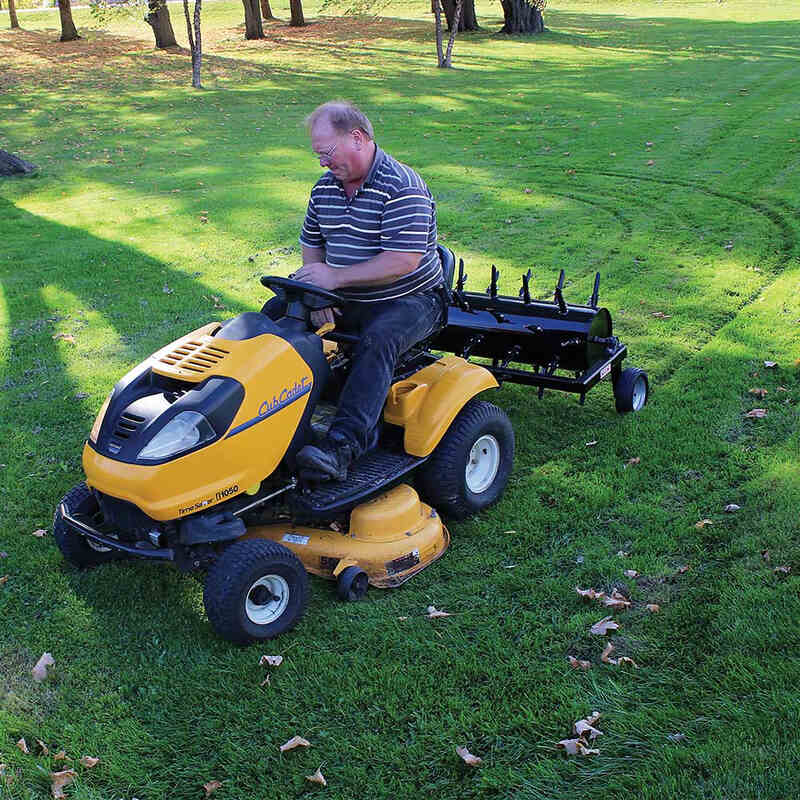
Maxim Plug Aerator | 36-In. Tow-Behind
A 36-inch plug aerator with 36 hollow tines, 4-inch core depth, and a 2-year warranty. More maneuverable than wider units on standard residential lots with tighter turns.
Shop Now
1st Products AE40E AERA-vator | Tow-Behind
A motorized aerator with vibrating forged tines at 825 cycles per minute, reaching 8 holes per square foot at 3 3/4-inch depth. Built for large properties or buyers who aerate more than once per season.
Shop NowStep 1: Mark every sprinkler head and shallow utility. Flag all irrigation heads, shallow supply lines, and utility markers before the aerator contacts the ground. A tine through a sprinkler head requires a service call.
Step 2: Water 1 inch the day before. Moist soil allows tines to penetrate to their full operating depth. Dry soil causes tines to deflect off the surface rather than pulling a clean plug. The target is moist but not saturated; aerating on waterlogged ground plugs the hollow tines and reduces their effectiveness.
Step 3: Confirm tine depth before the first pass. Set the aerator to pull plugs at least 2 inches deep, targeting 2 to 3 inches. Most walk-behind rental units have a depth adjustment. Check it before the first pass.
Step 4: Make the first pass in one direction. Run the aerator across the full lawn in parallel rows, like mowing, in one direction. Overlap each pass slightly to avoid gaps.
Step 5: Make the second pass perpendicular. Rotate 90 degrees and run a second complete pass. The two-direction pattern achieves the hole density needed for effective compaction relief. Iowa State University Extension identifies 20 to 40 holes per square foot as the optimal density for residential lawn aeration, and two perpendicular passes on a properly calibrated machine comes close to that range.

Step 6: Add passes over compacted zones. High-traffic areas near driveways, gates, worn pathways, and play equipment benefit from one to two additional passes to reach adequate hole density.
Step 7: Leave the soil plugs on the lawn. Do not rake, blow, or bag the plugs. They break down in 2 to 4 weeks, returning organic matter and soil microorganisms to the surface. This is part of the process, not a cleanup step.
For yards under 2,000 square feet, or for targeting areas a machine cannot access, three manual approaches work for aerating a lawn without a machine.
Garden fork or spading fork. Push a standard spading fork at least 4 inches into the soil, rock it slightly forward and back to loosen the surrounding earth, then pull straight out. Move 4 to 6 inches and repeat. This is the most effective hand method for compacted soil because it genuinely disrupts the compaction layer. It is practical for areas under 500 square feet and increasingly labor-intensive beyond that.
Handheld rolling core aerator. A push-type or rolling tool with hollow tines that pull small plugs with each pass. More efficient than a fork for a small lawn or a specific patch in the 500 to 2,000 square foot range. Available at most garden centers. This is the most realistic way to aerate a small lawn without renting a powered machine.
Aerator shoes. Spike-type attachments that strap to boots. These deliver spike aeration, not core aeration. On compacted ground, the spikes often cannot penetrate to meaningful depth at body weight alone, and the displaced soil increases compaction laterally around each hole. Aerator shoes are not a substitute for core aeration on any lawn with visible compaction. They may have marginal value for light surface airflow on already-loose soil between aeration seasons.
How to aerate a lawn manually in the most effective sense means committing to the fork or handheld core method, not the shoe approach. The results are slower and more labor-intensive than a machine, but they work on small areas where renting is not cost-effective.
Aeration and overseeding pair naturally because the open holes left by the tines provide direct seed-to-soil contact, which significantly improves germination rates compared to broadcasting seed onto an intact lawn surface. Seed that falls into an aeration hole has protected contact with moist soil rather than sitting on the surface exposed to sun and wind.
The sequence: aerate first, overseed immediately after aeration while holes are still open, apply starter fertilizer within 48 hours. Do not apply a pre-emergent herbicide in the same window because it will prevent seed germination along with weed seeds.
Even coverage of seed and starter fertilizer matters more than exact rate. Broadcast spreaders distribute seed and granular fertilizer evenly across the full lawn area, eliminating the uneven coverage and overlap gaps that lead to patchy germination when casting by hand.
After seeding, water lightly once or twice daily for the first 3 to 5 days to keep the seed bed consistently moist. Avoid heavy irrigation that washes seed out of the aeration holes. Extend mowing intervals by at least one week after overseeding to allow young seedlings to establish before blade contact.


Swisher 80lb Spreader Vibrator Kit
Adds a vibrator motor to an existing spreader to eliminate seed bridging and clogging during overseeding, the most affordable way to improve distribution consistency on small to mid-size lawns.
Shop Now
Tomahawk 4 Gallon Motorized Backpack Spreader
A motorized backpack spreader for precise overseeding coverage on slopes and tighter areas a tow-behind cannot reach, with 4-gallon capacity suited to most residential lot sizes.
Shop Now
Swisher Commercial Pro ATV Spreader
A tow-behind ATV spreader with a large hopper for even seed and starter fertilizer distribution across a half acre or more in a single loaded pass, built for homeowners with larger lots.
Shop NowThe soil plugs left on the surface after core aeration look like lawn damage for the first week. They are not. Leave them in place.

Each plug contains soil microorganisms from the root zone. As the plugs break down over 2 to 4 weeks, those organisms return to the surface and contribute to thatch decomposition. Mowing over dried plugs after a week or so breaks them into smaller pieces and speeds the process without any special effort.
For lawns with significant thatch accumulation alongside compaction, aeration alone addresses the compaction layer but not the thatch mat. Tow-behind dethatchers run before aeration can remove the accumulated thatch layer and allow the aerator tines to penetrate to full depth without obstruction.
Water the lawn lightly for the first 2 to 3 days after aeration to support root recovery around the open holes. Resume the normal irrigation schedule after the first week.
Most lawns benefit from aeration once per year. Heavy clay soil or high-traffic yards may need twice per year. Sandy, low-traffic lawns can go every 2 to 3 years. The screwdriver test works as a diagnostic: if a screwdriver resists pushing 6 inches in, the lawn needs aeration.
Walk-behind aerator rentals run in the low-$100s per day. Professional lawn aeration of a standard residential lot typically runs in the low-$100s to mid-$200s, depending on lawn size, region, and whether the service includes overseeding or fertilizer application.
Early fall is the primary window for cool-season grasses such as fescue, bluegrass, and ryegrass, at least 4 weeks before the first frost. Warm-season species, including bermuda, zoysia, and St. Augustine, are best core aerated in late spring through early summer.
Core aerators should pull plugs to a minimum of 2 inches deep, with 2 to 3 inches being the ideal target for most lawns. Heavy clay soils benefit from maximum tine depth. Dry soil limits penetration, which is why watering the day before aeration is a required step.
A typical residential lot of 5,000 to 10,000 square feet takes 1 to 2 hours with a walk-behind core aerator, including two perpendicular passes. Larger properties or extra passes over compacted zones extend the time. Manual hand aeration takes longer per square foot.
Yes. Core aeration removes plugs of soil, opening channels for air, water, and nutrients to reach roots. Spike aeration pushes soil sideways, compacting the surrounding earth with each hole. For any lawn with measurable compaction, spike aeration can make the problem worse.
Core aeration in the right window for the grass type is the most reliable path to a thicker, healthier lawn. The timing and the two-direction overlapping pass technique matter more than the specific equipment brand. Getting both right, along with the pre-aeration watering step, determines whether the lawn recovers quickly or sits with open holes through an unfavorable stretch of weather.
Root Revive Direct carries lawn aerators from walk-behind units suited to standard residential lots through tow-behind models for larger properties or more frequent use.