


A landowner standing at the edge of a field that hasn't been touched all season faces two very different jobs disguised as one question. Waist-high grass, scattered saplings, and matted weeds call for a different machine than a field already under control, which is exactly what the brush hog vs finish mower decision comes down to. A lawn that's already under control just needs a clean, even pass.
Buying the wrong one first means either grinding a finish mower's blades to a halt on brush it was never built for, or paying for a brush hog's horsepower on ground that never needed it. Root Revive Direct's rough cut mowers collection covers the heavy end of that decision, built to pull behind a tractor already parked on the property. Sorting out which tractor mower a land clearing or maintenance job calls for starts with naming the tools correctly.
Key Takeaways
| Brush Hog | Finish Mower | |
|---|---|---|
| Also called | Bush hog, rotary cutter, rough cut mower | Finish cut mower |
| Blade type | Thick, hinged, dull; swings back on impact | Sharp, rigid, high-RPM |
| Max grass height | No limit; handles waist-high growth | Under 8 inches |
| Handles brush / saplings | Yes, up to a few inches diameter | No |
| Cut quality | Rough, uneven | Clean, manicured |
| HP rule (PTO) | 5 HP per foot of cutting width | 3-4 HP per foot |
| Best for | Land clearing, reclamation, first pass | Routine lawn maintenance, second pass |
Brush hog, bush hog, and rotary cutter all describe the same class of machine. Bush Hog is a brand name that became generic the way Kleenex or Jacuzzi did, so hearing all three terms used interchangeably at a dealer or in a forum thread is normal, not a sign of three different tools.
The blades are thick, dull, and mounted on hinges that swing back on impact instead of snapping when they hit a rock or a stump. That hinge is what lets a brush hog tear through saplings and heavy brush without destroying itself in the process. What some buyers call a rough cut mower is simply a brush hog described by function rather than brand history.

A finish mower works on the opposite end of the job. Sharp blades stay rigidly mounted to the spindle and spin at a higher RPM, built to trim grass evenly rather than tear through it. Most models ride on three wheels, spreading weight to reduce soil compaction on lawns that already look decent.
That design only performs well on grass already under roughly 8 inches. A tractor finish mower pushed into taller growth strains the blades and leaves a rough, uneven result instead of the manicured cut it's designed for.

Horsepower matters more than deck width alone. The standard rule for brush hogs is 5 HP at the PTO per foot of cutting width. Finish mowers need roughly 3 to 4 HP per foot.
A rough cut mower undersized for its own deck bogs down exactly when the vegetation gets thickest, which is the worst moment for it to lose momentum.
Most comparisons list grass height and brush diameter as two separate checklists. The faster way to decide is running both at once. Walk the field and check two things together: how tall the grass is, and whether anything woody thicker than a pencil is mixed into it.
Grass under 8 inches with nothing woody in it is finish mower territory. Anything taller, or any saplings and brush mixed in regardless of grass height, calls for a brush hog first. Mixed conditions, tall grass with scattered brush, mean a brush hog pass now and a finish mower pass later once the ground is under control.
| Ground Condition | Right Tool |
|---|---|
| Grass under 8 inches, no woody growth | Finish mower |
| Grass over 8 inches, no brush | Brush hog first, then finish mow once it's down |
| Any saplings or brush present | Brush hog regardless of grass height |
| Mixed tall grass and scattered brush | Brush hog now, finish mower after regular mowing brings it down |
NC State Extension's research on pasture grazing heights backs up why the first pass matters as much as the second. Stop heights for mechanical clipping run from 2 to 3 inches for bermudagrass up to 5 to 7 inches for big bluestem, protecting the plant's energy reserves so it recovers faster.
Cutting too low on the first pass, whichever tool is doing the cutting, sets regrowth back regardless of how clean the mower left the field looking.

A flail mower sits between the other two, using dozens of small blades enclosed in a rotating drum instead of two long blades swinging free. That enclosure keeps debris and rocks from launching the way a brush hog can, and the finer cutting action leaves a more even finish on rough ground than a brush hog manages.
Brush hog vs flail mower comes down to raw capability versus finish quality. A brush hog still wins on thick saplings and heavy brush that would overload a flail's smaller blades. For ditches, roadsides, or land mowed near foot traffic where flying debris is a real concern, a flail mower's enclosed design is worth the tradeoff.
Property owners handling cleared brush and limbs after either pass often reach for a PTO wood chipper to deal with what gets left behind.

An acreage owner clearing reclaimed land for the first time in years usually needs the brush hog side of this comparison. A 44-inch deck at 19 HP lines up almost exactly with the 5 HP per foot rule, enough power to keep blades spinning through saplings and matted growth without stalling out mid-pass.
Once that same ground is under control, a finish mower with a smaller engine handles the maintenance passes that follow. A 40-inch deck at 10.5 HP is plenty for grass that's already being kept short, since it's trimming rather than tearing.
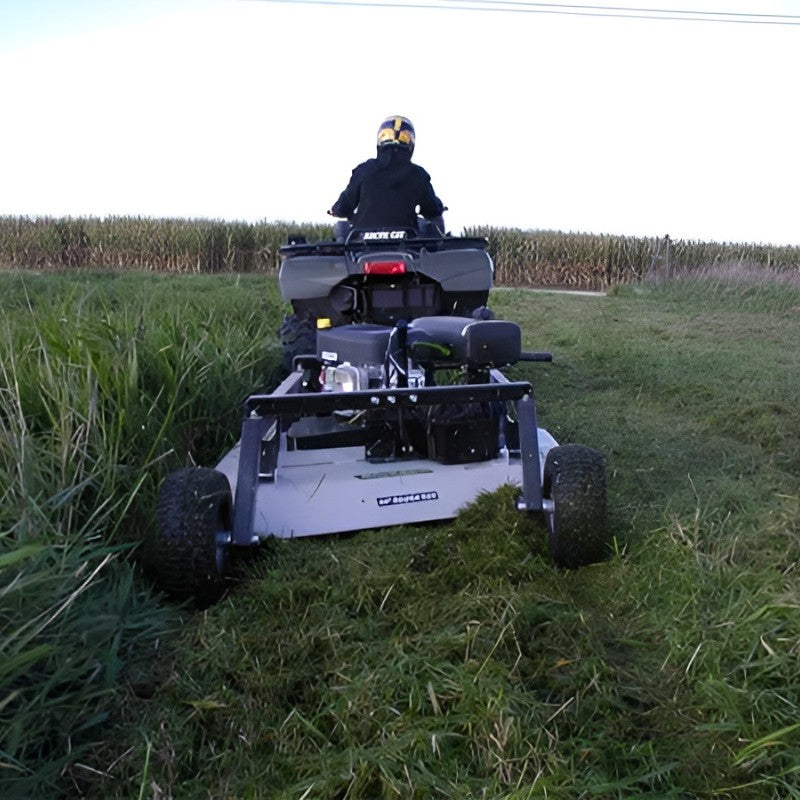
Kunz Engineering Rough Cut Mower AcrEase Model MR44B
A 44-inch tow-behind brush hog at 19 HP, sized for acreage owners clearing tall grass, weeds, and light brush in a single pass.
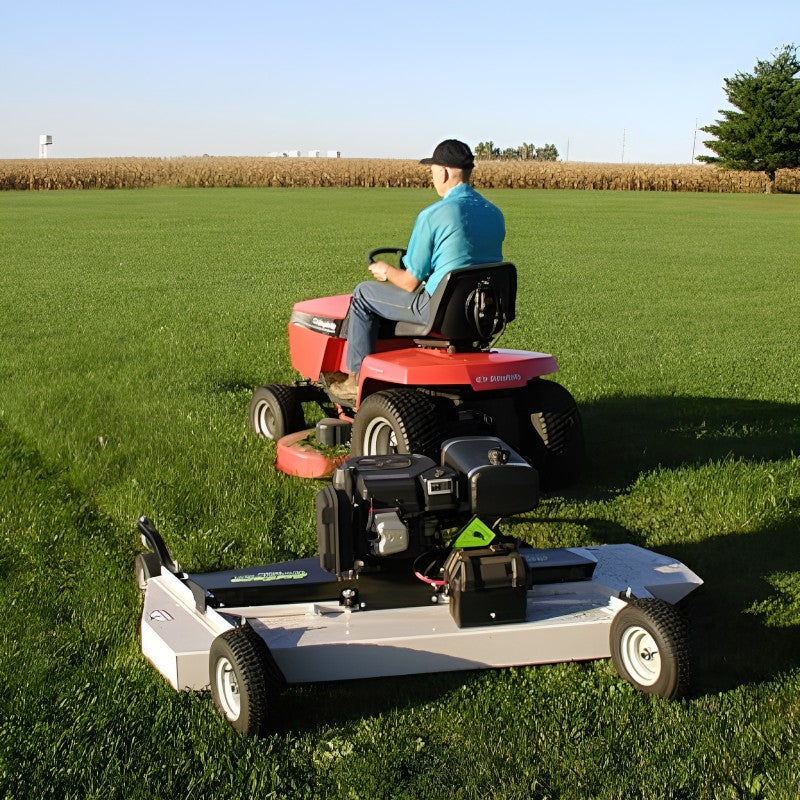
Kunz Engineering Finish Cut Mower AcrEase Model H40B
A 40-inch finish mower at 10.5 HP, built for maintaining grass that's already under control rather than clearing overgrowth.
Shoppers browsing finish mower for sale listings sometimes skip straight to deck width without checking whether the ground is even ready for one. The finish mowers built for already-maintained acreage aren't the same purchase as the brush hog needed to get there first.
Looking at finish mower vs brush hog on newly reclaimed land, the answer is usually both in sequence rather than a choice. A brush hog clears the tall grass, weeds, and light brush first, then a finish mower follows once regular mowing has brought the grass down to a manageable height.
That two-step approach also lines up with buying season. Most acreage owners start this project in late spring or early summer, right as overgrown fields from winter dormancy become obvious and before the heat makes clearing work harder. Once both tools are in place, ongoing pasture maintenance becomes a routine pass rather than a major clearing project each season.
Both terms are correct and used interchangeably across the industry. Bush Hog is a brand name that became generic for the category, the same way people say Kleenex for tissue. Rotary cutter and rough cut mower describe that identical machine by function rather than brand.
Not effectively, and doing so risks real damage. Finish mowers use sharp, rigid blades built for grass under about 8 inches, and pushing one into taller growth strains both the blades and the deck. A brush hog should clear overgrown land before a finish mower ever gets near it.
The standard rule of thumb is 5 HP at the PTO for every foot of cutting width, measured at the tractor rather than the engine label. A 5-foot brush hog needs at least 25 HP, and a 7-foot deck calls for 35 HP or more to keep blades spinning through thick material.
No, brush hogs prioritize durability and raw cutting power over finish quality, leaving a rougher cut than a finish mower produces. If a manicured appearance matters, a finish mower pass should follow once the brush hog has cleared the heavier growth to a manageable height.
There isn't a real difference between them. Rough cut mower describes the same machine as brush hog, bush hog, and rotary cutter, just named for what the tool does rather than for the brand that popularized it. All four terms point to one hinged-blade design built for brush.
It depends on which priority matters more. A flail mower's enclosed blades leave a finer, more even cut and contain flying debris far better, but a brush hog still handles thicker saplings and heavier brush that would overload a flail mower's smaller, more numerous blades.
The field itself answers this question before any spec sheet does. Tall grass mixed with brush and saplings needs a brush hog's hinged blades and horsepower. Grass already under control just needs a finish mower's sharper, rigid blades for an even pass.
Measure the ground first, match the horsepower to the deck width, and the right machine becomes obvious. Root Revive Direct's rough cut and finish mower lineup covers both ends of that decision for owners ready to stop renting and start owning the right tool for the acreage they actually have.